
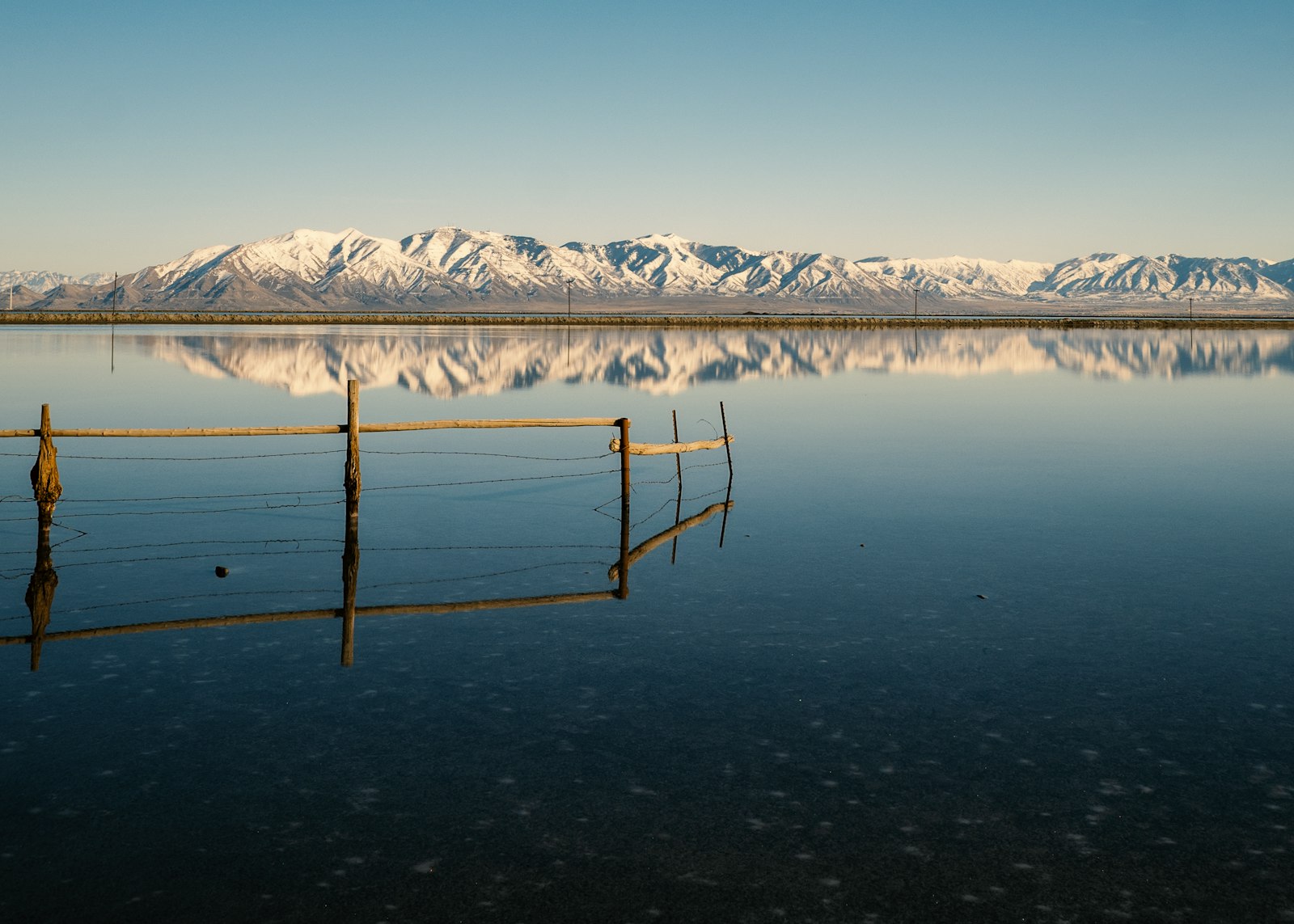
The Great Salt Lake ended the 2025 water year at 4,191.1 feet—the third-lowest elevation recorded since measurement began in 1903, per the Kem C. Gardner Policy Institute. It rose slightly into the spring of 2026, peaking in late April at 4,192.6 feet—a foot below the 2025 peak and still more than five feet below the minimum healthy range. Hydrologists are calling the current water year the "no-pack" year for its anemic snowpack. State scientists classify the lake's current range as "serious adverse effects." Climate scientists call it the leading edge of a slow-moving crisis. Most Utahns, if they think about it at all, call it "low."
Pragmatic conservatives ought to call it something else: a test.
For decades, the political right has argued that conservative governance—limited, accountable, focused, locally driven—can solve hard problems at least as well as more expansive models. The Great Salt Lake is one of those hard problems. It is multi-generational, scientifically complex, economically tangled, and politically inconvenient. It is also a problem Utah has chosen to take seriously, and the early results are worth examining carefully.
Why the Lake Matters
Skip the lake's importance and the rest of this conversation makes no sense, so let's get it on the table fast.
- Utah's mineral, brine shrimp, and recreation economies tied to the lake are worth billions annually.
- The lake's exposed lakebed contains arsenic, antimony, and other heavy metals; dust events from a depleted lake have direct public-health consequences for the Wasatch Front.
- The lake drives lake-effect snow that feeds the Wasatch watershed—the same watershed that supplies most of Utah's drinking water.
- It supports a hemispheric flyway for migratory birds that has no analog anywhere else on the continent.
This is not an aesthetic problem. A failed Great Salt Lake is a generational economic, public-health, and ecological hit to the most populous part of the state.
What Utah Has Already Done
To anyone who pays attention only to national coverage, the Utah story on the lake is "drying up." That is incomplete to the point of being wrong. The real story is that, over the last five years, a remarkable amount of work has actually happened.
Between 2021 and 2025, the state dedicated and delivered nearly 400,000 acre-feet of additional water to the Great Salt Lake through a combination of water leasing, conservation programs, and large-scale phragmites removal. The legislature created the Office of the Great Salt Lake Commissioner, appointed Brian Steed to lead it, and gave it both a strategic plan and recurring funding. The state passed mandatory tiered-pricing requirements on secondary water suppliers, forcing the historically wasteful "flat-rate sprinkler" model to start reflecting reality. Compass Minerals and Morton Salt—two of the lake's largest mineral extractors—agreed to forgo significant water use as part of state agreements. Approximately 700,000 acre-feet of water has moved through river systems toward the lake in coordinated releases.
In September 2025, Governor Cox, the Commissioner's Office, the legislature, and a coalition of private donors signed the Great Salt Lake 2034 Charter—a ten-year framework targeting healthier lake levels by the 2034 Salt Lake Winter Olympics, backed by $200 million in initial private commitments. The 2034 Plan layers onto the Great Salt Lake Strategic Plan released in 2024 and the ongoing work of the bipartisan Great Salt Lake Strike Team.
The 2026 legislative session built on that foundation with nearly $100 million in additional commitments and eleven lake-related bills. That brings the total state appropriation for Great Salt Lake conservation to more than $300 million since 2022—including $200 million for agricultural water optimization, $40 million for the Watershed Enhancement Program, $30 million to purchase US Magnesium's water rights, and $2.75 million for the newly created Great Salt Lake Preservation Program. The state also locked in a $60 million federal settlement tied to the Bear River Migratory Bird Refuge, with $10 million immediately available to the Commissioner's Office.
Three bills from the 2026 session deserve specific attention. HB 247 expanded annual funding for the lake by raising the brine shrimp royalty tax and directing the revenue into the Sovereign Lands Management Account, which can be used to lease water rights. HB 410 created the $2.75 million Great Salt Lake Preservation Program to lease agricultural water directly for the lake. And HB 348—widely viewed as the most consequential legal change of the session—cut red tape that had been delaying water transfers to the lake.
Whatever else you think about the speed or scale of all this, you should think this: it happened. In five years. Under a Republican governor, a Republican-supermajority legislature, and a state that, in the eyes of its critics, supposedly cannot or will not engage seriously with environmental questions. The work is real.
What's Actually Working
A few patterns from the last four years are worth naming, because they will matter for the next ten.
Conservation pricing works
The single biggest unforced error in Utah's water history was charging people the same amount whether they watered a lawn for ten minutes or ten hours. Tiered pricing—where you pay more the more you use—is, by every honest measure, the most cost-effective lever the state has. It is also a deeply conservative policy: it lets price signals do the work that mandates and shaming cannot.
The Commissioner's Office model works
Creating a single point of accountability—a commissioner with budget, statutory authority, and a strategic plan—forced the lake to stop being everyone's responsibility and therefore no one's. That is governance 101, and Utah was right to do it. Commissioner Steed has been blunt that delivering more water to the lake is far cheaper than managing the impacts of a perpetually depleted one. That kind of clear-eyed framing is exactly what a long recovery requires.
Public-private partnerships move faster than appropriations alone
The $200 million in private commitments announced with the 2034 Charter did not displace state action—it amplified it. When mineral companies, conservation groups, agricultural interests, and the state actually sit at one table, the conversation gets less about who wins and more about what works. That is the Utah model in microcosm.
Delivering more water to the lake is far more cost-effective than managing the impacts of a lake at perpetually low levels.
— Commissioner Brian Steed
What Isn't Working Yet
It would not be honest to leave the assessment there. The math is still harder than the headlines suggest.
To get the lake back to its healthy range of 4,198 feet, hydrologists estimate the state needs an additional 800,000 acre-feet per year of sustained inflow—roughly double what has been delivered in total over the last five years. The 2034 timeline, now formally tied to the Salt Lake Winter Olympics, is aggressive, and most of the cheapest conservation gains have already been claimed.
Even with the 2026 session's gains, independent analysts have been candid that the current trajectory still doesn't put Utah on pace to meet the 2034 commitment. Advocacy groups have called it a "good but not great" session—real progress, but not yet the scale the math requires.
Urban and suburban water use is the biggest unresolved gap. The 2026 session made meaningful changes around agriculture, mineral extraction, and water transfer mechanics—but did relatively little to address the lawns, irrigation patterns, and pricing structures that drive Wasatch Front household consumption. That is the next frontier, and it is politically harder because it touches every voter.
Agricultural water rights remain the largest pure-volume variable. Roughly two-thirds of the state's water historically goes to agriculture. The US Magnesium acquisition and the new agricultural leasing program are meaningful steps, but recovering the lake without continuing to compensate, modernize, and partner with the agricultural sector is impossible, and doing all three is politically expensive in every direction.
And the climate trend is not waiting. The current water year's "no-pack" snow conditions are a reminder that even disciplined recovery work happens against a hotter, drier basin. That is not a reason to give up—it is a reason to be faster, smarter, and less performative about the work.
Why This Is a Conservative Question
It is fashionable to assume that long-horizon environmental policy is the natural turf of the political left. That assumption is wrong on both the history and the philosophy.
Conservatism, properly understood, is the politics of stewardship. It is the disposition that says we did not invent the institutions we inherited and we do not get to use them up. Burke wrote about this. Roosevelt practiced it. Reagan, despite his caricature, signed major conservation legislation. The conservative case for protecting the Great Salt Lake is not borrowed from somebody else's worldview. It is native to ours.
The deeper test is whether pragmatic conservatives can hold a coalition together for a decade. The Great Salt Lake will not recover in a single legislative session, a single governor's term, or a single primary cycle. It will recover—if it recovers—because successive generations of leaders chose to fund the work, defend the work, and resist the constant temptation to cash in the long-term plan for a short-term political win.
That is harder than it sounds. Recovery work is the opposite of viral. It is meetings, contracts, water accounting, and quiet announcements. It produces almost no cable-news moments. The political reward for doing it well is largely invisible until it isn't.
What the Next Decade Requires
If the Great Salt Lake is going to be a success story rather than a cautionary one, three things have to hold.
- The Commissioner's Office and the Strike Team need durable funding. Not heroic one-time appropriations, but the kind of steady, multi-year budgets that allow planning beyond the next session. A serious problem deserves a serious operating budget.
- Agriculture has to be a partner, not a target. The fastest way to lose the lake is to lose Utah's farmers and ranchers. Pragmatic conservatism means modernizing irrigation, paying for water leases, investing in efficiency, and rewarding cooperation—not pretending the lake can be saved without the people who hold most of the water.
- Voters have to keep electing leaders who can carry the long view. A ten-year plan dies the first time the legislature elects an activist majority more interested in fighting than fixing. Primaries are where this gets decided.
The Bottom Line
The Great Salt Lake is not a metaphor. It is a real, measurable, navigable problem with a clear current elevation and a clear target elevation. Utah has done more in five years—now well over $300 million committed, eleven bills in the 2026 session alone, a Commissioner's Office with a strategic plan, and the 2034 Olympics as a hard deadline—than its national critics will ever credit. It has also done less than the long-term math demands. Both things are true at once.
For the Republican Roundtable PAC, the lake is exactly the kind of problem our model of pragmatic, principled conservatism was built for: long, complex, politically inconvenient, and entirely solvable by leaders who know the difference between governing and posturing. Whether Utah meets its 2034 commitments will say a great deal about which kind of leadership we keep electing.
If you'd like to help us recruit and support the leaders who will see this work through, join us. The lake is patient with no one, and the decade in front of us starts now.
Sources
- Great Salt Lake ends 2025 water year at third-lowest level on record — Kem C. Gardner Policy Institute
- The Great Salt Lake has already reached its max height for the year — Utah News Dispatch
- GSL 2034 — Office of Governor Spencer J. Cox
- Utah is Making Progress on Great Salt Lake — Kem C. Gardner Policy Institute
- Great Salt Lake Strategic Plan released — Utah Department of Natural Resources
- Utah's 2026 Great Salt Lake Laws — Utah House of Representatives
- 2026 session was good for Great Salt Lake, but it could have been great — KSL
- Utah Made Progress on Great Salt Lake in 2026 Session, But Major Gaps Remain — Grow The Flow Utah
- Great Salt Lake legislative update — S.J. Quinney College of Law
Photo by Ruston Jones on Unsplash