
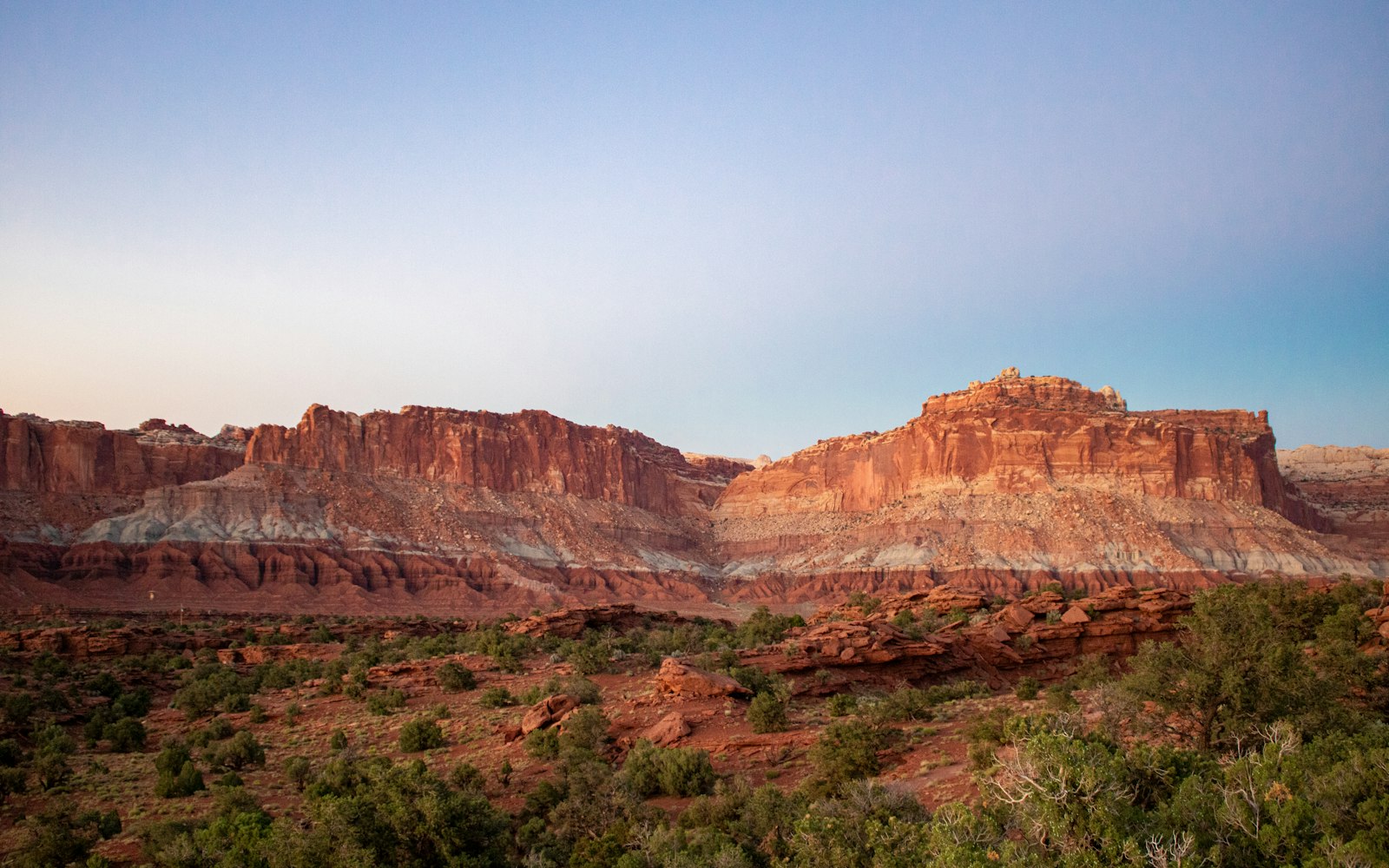
The case for local control of Utah's public lands begins with a single, stubborn number. The federal government owns 64.4 percent of Utah's land—about 35 million of the state's 54.3 million acres, the second-highest share of any state after Nevada. When the debate over Utah public lands and federal control gets heated, that figure is why. It is hard to run a state, fund its schools, or manage its own resources when Washington controls two acres out of every three.
To be clear about what the argument is not: no serious Utah leader is proposing to lock the gates on the canyons Utahns hike, hunt, and camp in. The pragmatic conservative position is narrower and more defensible than the caricature—that decisions about land inside Utah's borders should be made closer to the Utahns who live with them, and that the federal government should not be able to hold vast tracts indefinitely with no plan and no accountability.
The Scale of Federal Control in Utah
Utah is not an ordinary state when it comes to who owns the ground. According to the Kem C. Gardner Policy Institute, the federal estate in Utah breaks down mostly across three agencies: the Bureau of Land Management manages roughly 68.5 percent of it, the U.S. Forest Service about 24.6 percent, and the National Park Service around 6.3 percent.
That concentration has real fiscal consequences. Federal land cannot be taxed by a county the way private land can. To offset that, the federal government sends counties Payments in Lieu of Taxes—but those payments are set in Washington, subject to the annual appropriations fight, and rarely track what the land would generate under active local management. A rural Utah county sitting on millions of acres it cannot tax, develop, or fully steward is a county with one hand tied behind its back.
The Lawsuit: What Utah Asked, and What the Court Said
In August 2024, Utah took the fight to the highest court in the country. The state filed a lawsuit challenging federal control over roughly 18.5 million acres of "unappropriated" BLM land—land that has never been formally designated for a specific purpose. That is a critical distinction, and it is often lost in the shouting.
The suit deliberately excluded "appropriated" lands: national parks, national monuments, wilderness areas, national forests, Tribal lands, and military properties. Zion stays Zion. Arches stays Arches. The question Utah raised was narrower: can the federal government hold unappropriated land within a state indefinitely, with no intent to ever transfer or dispose of it? As Governor Spencer Cox put it when the suit was filed:
It is not a secret that we live in the most beautiful state in the nation. But, when the federal government controls two-thirds of Utah, we are extremely limited in what we can do to actively manage and protect our natural resources.
The legal path did not go Utah's way. In January 2025, the U.S. Supreme Court declined to take the case, denying Utah's motion to file its complaint directly with the Court and offering no reasoning. That ended one route, not the effort. The state signaled it would consider refiling in federal district court, and through 2025 the question of whether and how to do that worked its way through both the courts and the political process.
Responding to the Supreme Court's decision, Cox framed the state's posture this way: "We will continue to fight to keep public lands in public hands because it is our stewardship, heritage and home."
What "Local Control" Actually Means
Here is where the conversation needs more precision than either side usually gives it. "Local control" is not a synonym for "sell it off." The strongest version of the conservative argument is about management authority and access, not liquidation.
Consider what a state or county actually gains from a bigger seat at the table:
- Wildfire and forest health. Overgrown, unmanaged federal timber is a tinderbox. States with management authority can thin, graze, and clear on a faster timeline than a distant agency working through a multi-year environmental review.
- Multiple use, honestly balanced. The best land policy keeps room for recreation, grazing, responsible resource development, and conservation at the same time. Local managers are better positioned to weigh those uses because they answer to the neighbors affected by them.
- Access. Utahns want trailheads open, roads maintained, and permits processed in a reasonable time. Those are administrative functions that suffer under remote control and thin budgets.
- A tax base that funds schools. Land that produces nothing for local government still costs local government to service. Getting that math right is not greed—it's how rural Utah keeps its classrooms staffed.
These are the same instincts Utah brings to energy policy and to its stewardship of the Great Salt Lake: manage actively, balance competing uses, and hold someone accountable for the outcome.
Why This Is a Conservative Issue
Federalism is the oldest conservative argument there is. The framers did not design a system in which a national bureaucracy would permanently govern most of the physical territory of a sovereign state. When Attorney General Sean Reyes described the state's complaint, he tied it directly to that principle: "Current federal land policy violates state sovereignty and offends the original and most fundamental notions of federalism."
You can agree or disagree with the legal theory and still see the deeper point. A government closest to the people is usually the one most responsive to them. A rancher in Kane County, a county commissioner in Emery County, and a family that has recreated on the same BLM parcel for three generations all have knowledge that no Washington land-use plan captures. Devolving decisions toward them is not radical. It is the ordinary conservative preference for subsidiarity—handle a problem at the lowest level competent to handle it well.
The Honest Caveats
Pragmatic conservatism earns its credibility by naming the hard parts, so here they are. Managing 18.5 million acres is expensive, and any serious transfer proposal has to answer honestly how the state would pay for firefighting, road maintenance, and law enforcement across that expanse. Utahns across the political spectrum are rightly wary of anything that sounds like a first step toward selling public land to the highest bidder—and that wariness is a feature of a state that loves its outdoors, not a bug to be argued away. Tribal nations have their own sovereignty and their own claims that any credible plan must respect, not paper over.
None of those caveats defeats the underlying case. They discipline it. The goal is not to win a slogan; it is to build a land-management arrangement that is more accountable, better funded, and more responsive to Utahns—while keeping public land genuinely public and genuinely accessible.
What Comes Next
The Supreme Court's refusal to hear the case slowed the legal effort but did not settle the underlying question. Expect the debate to continue on several fronts at once: further litigation over specific BLM management decisions, negotiations in Congress over land designations and PILT funding, and the quieter, more consequential work of county-level land-use planning. Many of the decisions that shape how Utahns actually experience their public lands run through county commissions, where turnout is low and the stakes are high.
That is the real lesson of the public-lands fight. Grand constitutional arguments make headlines, but the day-to-day reality of who can hike a trail, graze a herd, or fund a school is decided in dozens of smaller rooms—and it is decided by whoever shows up.
The Republican Roundtable PAC supports a Utah that manages its own resources with the seriousness and stewardship they deserve—the kind of pragmatic, principled conservatism that keeps public land public while insisting it be managed close to home. If that's the Utah you want to build, join us. This is a fight measured in decades, and it needs Utahns who will stay in it.
Sources
- Federal government owns 64.4% of Utah's land, the second-highest share in the nation — Kem C. Gardner Policy Institute
- Utah files landmark lawsuit challenging federal control over most BLM land — Office of Governor Spencer J. Cox
- Supreme Court declines to hear Utah's public lands case. What happens next? — KSL
- Despite Supreme Court decision, Utah remains committed to keeping public lands accessible for all — Office of Governor Spencer J. Cox
- Could Utah re-file its public lands lawsuit? The state — and a judge — are deliberating — Utah News Dispatch
Photo by Zoshua Colah on Unsplash